Researcher Spotlight – Maggio Laquidara
2025-26 Global Change Research Fellow
PhD Student, Forestry and Environmental Resources
Advisor: Dr. Meredith Martin
About You
What do you study?
I am a Ph.D. student in the Forestry and Environmental Resources Department at the North Carolina State University College of Natural Resources. My field of study in urban forestry. Together with Dr. Meredith Martin, we study ways in which urban forests across the Southeast U.S. can withstand climate change and rapid urban expansion.
Who influenced you to go into this field of study?
The person I first learned about urban forestry from is Dr. Renata Poulton Kamakura, when they were a Ph.D. candidate at the Duke University Nicholas School of the Environment and I an undergraduate student. Renata is truly a person who may impress you in all possible ways, and they rapidly became a model for the student-researcher I would rely on throughout the following years. I vividly remember how she first taught me to identify my first tree species, a Japanese maple in the department’s garden.
What do you think is the most pressing issue related to global change?
I am not sure I have the skills to identify the most pressing among a number of issues that seems to expand every moment! I think that the dimension of climate change that thrills me the most is the way people will have to change their relationship with nature. What we have come to see as the reliable background for our sustenance, leisure, work, and personal life may suddenly appear scarce and unpredictable. As a student, I have learned about how entire societies were swept away, transformed, and rebuilt due to a sudden drought, an unknown pest, or the unexpected extinction of a key food resource. Can we possibly predict such complex transformations happening, perhaps all at once and all of a sudden?
About Your Research
What results are you finding?
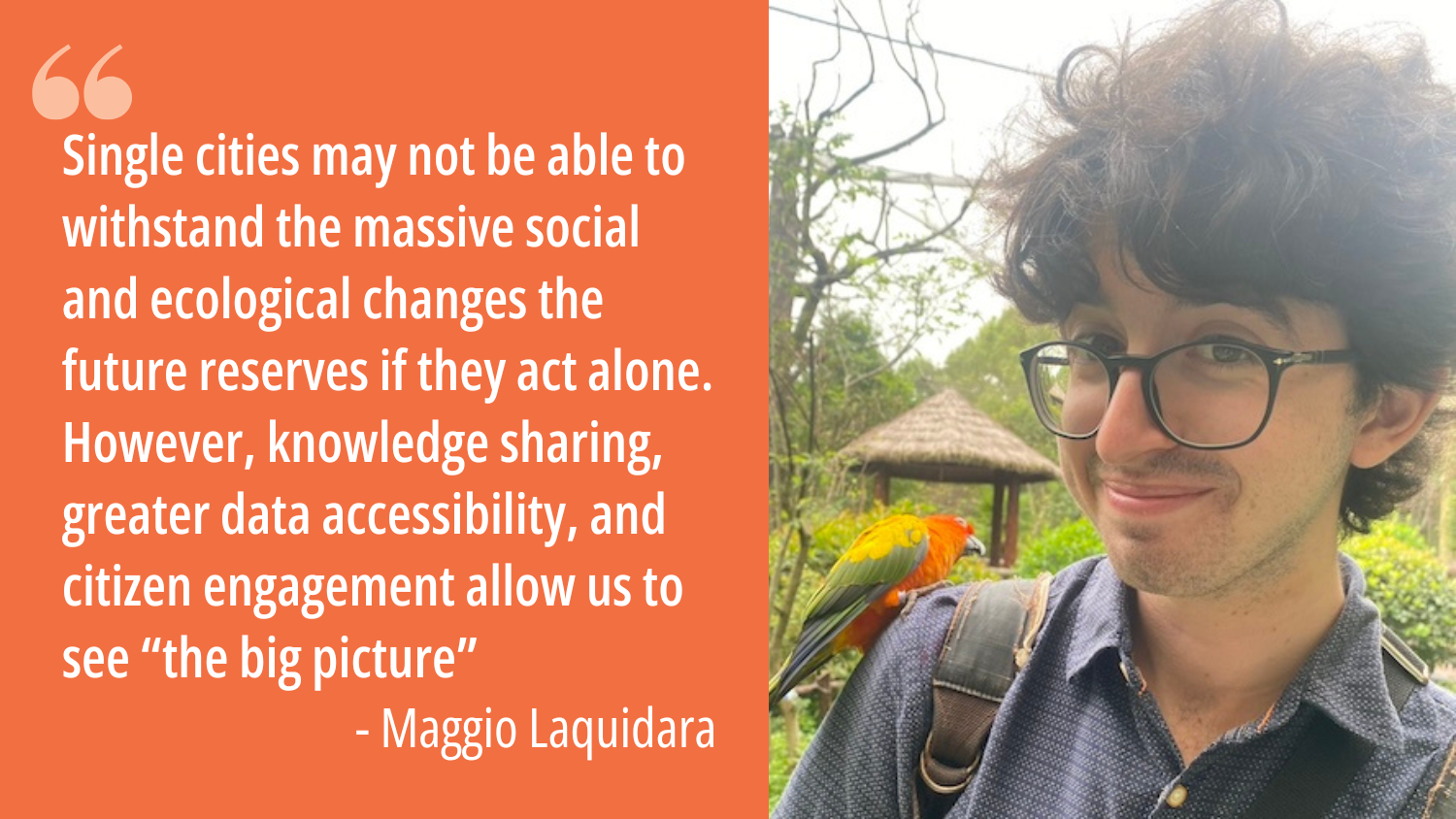
After reviewing the way Southeastern U.S. cities manage their resident forests, my lab and I are finding that our region holds a rich knowledge of urban nature, but that such a knowledge may be too scattered to develop a comprehensive strategy against climate change. Single cities may not be able to withstand the massive social and ecological changes the future reserves if they act alone. However, knowledge sharing, greater data accessibility, and citizen engagement allow us to see “the big picture,” detecting threats, identifying possible solutions, and giving urban forests a chance to ease their way through global change.

Who will benefit from your research?
I hope that our partners at the City of Durham, local NGOs Keep Durham Beautiful, and the Durham County Cooperative Extension, as well as all the citizen volunteers who have helped me and my teammates identify trees and measure their health have already benefited from our time together. I certainly have benefited from their patience, energy, wits, and generosity. I also hope that governmental and non-governmental urban foresters, certified arborists, and passionate tree keepers around the region will be able to make use of our findings.
How would you describe your research to a 3rd grader?
Aha, a brilliant cousin-in-law of mine is currently attending the 3rd grade. Let me practice! Trees that live in cities are very special, because they make the air cleaner, offer housing to squirrels and raccoons, occasionally produce tasty fruits, and allow us to have picnics and play hide-and-seek in the shade during the summer. Trees in Raleigh, Miami, Atlanta, and D.C. are all very different, but they all help us in these many ways. Unfortunately, Raleigh, Miami, Atlanta, and D.C. are getting warmer and warmer every year, and when it becomes too warm, the trees get sick and sometimes die. Do we know how many trees are sick, and how many trees have died already? And do we know how to make them feel better? Let’s try to find out!
About Your Global Change Research Fellow Experience
How do you expect the SE CASC Global Change Research Fellows Program to impact you and your work?
I think I have learned so much from my first semester in the Fellows Program, chiefly thanks to the other fellows. During the Field Intensive retreat, there has been no conversation that did not leave me wondering how much more I could learn. The program has been a humbling experience, the kind that fills you with enthusiasm, and a genuine gratitude to be surrounded by so much brilliance, passion, and friendliness. As GCRF enters the Spring term, I look forward to conducting a collaborative literature review with my Team Research group, which consists of students with different interests, backgrounds, and personalities!
What advice would you give to a student that is interested in getting involved in your field?
Even if, as an urban forester, you will grow greatly attached to discrete, silent trees, don’t forget that so many different humans live in cities, too! I found unexpected conversations and spontaneous gestures of kindness to be the most rewarding moments in the field. People are like the “native species” of their own block, neighborhood, or even their bus stop. Whenever you take some time to observe and chat with them, you learn something about the secret lives of the city in which they live.
What has been the most rewarding part or your favorite part of being a SE CASC Global Change Research Fellow?
Feeling very impressed by my peers and realizing that I was part of the same program as them!
Learn more about the Southeast Climate Adaptation Science Center’s Global Change Research Fellows program.
- Categories: