Recapping the SE CASC Global Change Research Fellows’ Spring Webinar: “Participatory Science in Climate Adaptation Decision-Making”
This blog was written by 2025-26 Global Change Research Fellow, Asmit Neupane.
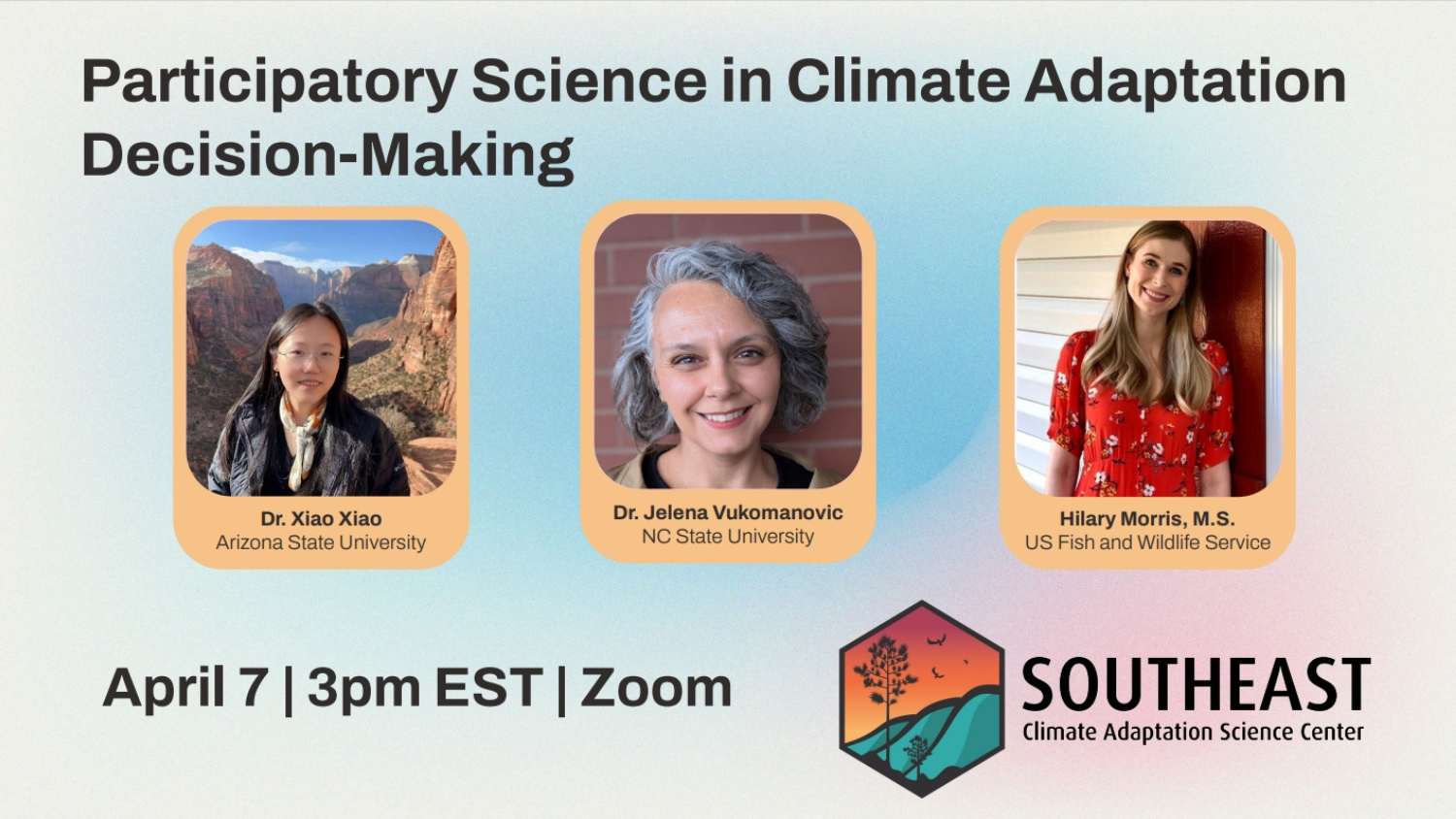
The 2025-26 Global Change Research Fellows hosted a spring webinar on April 7, 2026, focused on “Participatory Science in Climate Adaptation Decision-Making”. The session brought together three researchers/practitioners working at the interface of science, stakeholders, and decision-making, drawing an audience of approximately 100 participants. The goal was to highlight how participatory approaches and geospatial tools can strengthen climate adaptation efforts by making them more inclusive, practical, and grounded in real-world needs.
Over the course of 1.5 hours, three focused presentations were delivered, each addressing distinct dimensions of participatory science and its integration into climate-adaptive decision frameworks. The session concluded with a moderated panel discussion that allowed the audience to engage directly with the presenters.
Presentations
Dr. Xiao Xiao, School of Community Resources and Development, Arizona State University
Dr. Xiao is an associate professor at ASU and is currently based in Hainan as part of the ASU-HNU Joint International Program. Before joining ASU, she worked as a Postdoctoral Research Associate at NC State University, supported by the SE CASC. Her work centers on community-based natural resource management, human dimensions of conservation, and the role of participatory science in shaping climate adaptation strategies. Her research emphasizes how participatory approaches can improve decision-making by incorporating local knowledge, stakeholder perspectives, and socio-cultural context into planning processes. In the webinar, she discussed how co-produced knowledge systems can help bridge the gap between scientific research and community-level action, particularly in contexts where local ecological understanding intersects with formal conservation planning.
Dr. Jelena Vukomanovic, Department of Parks, Recreation and Tourism Management, North Carolina State University
Dr. Vukomanovic is an associate professor in Parks, Recreation, and Tourism Management in the College of Natural Resources and a faculty fellow in the Center for Geospatial Analytics at NC State. Her research focuses on the intersections of global environmental change, human behavioral responses, and land-use dynamics. In her presentation, Dr. Vukomanovic highlighted how innovative mapping and participatory modeling methods can reframe stakeholder engagement, enabling communities to actively contribute to and shape conservation and adaptation decisions in ways that are both scientifically rigorous and locally grounded.
Hilary Morris, Southeast Conservation Blueprint, Southeast Conservation Adaptation Strategy (SECAS)
Hilary is a User Support Specialist for the Southeast Conservation Blueprint. She also serves as the communications lead for the Southeast Conservation Adaptation Strategy (SECAS) partnership. With a decade of professional experience in landscape-scale conservation and science communication across the southeastern United States, she has developed particular expertise in translating complex spatial conservation data into accessible, user-friendly tools for diverse stakeholders. The Southeast Conservation Blueprint, which she supports, is a living spatial plan that integrates the best available data to identify priority areas for conservation action across the Southeast and Caribbean. Her presentation explored how the Blueprint functions as a participatory decision-support resource, enabling resource managers, landowners, and conservation practitioners to align local adaptation goals with regional priorities under a shared strategic vision.
Panel Discussion
Following the three presentations, the webinar transitioned into an open panel discussion that encouraged substantive dialogue between presenters and attendees. Questions from the audience guided the conversation toward identifying persistent gaps in participatory science practice where coordinated, cross-sector improvements could yield meaningful advances in climate adaptation. Panelists also examined the evolving role of geospatial technologies and community-centered modeling approaches in making climate adaptation decision-making more inclusive, transparent, and responsive to on-the-ground realities. The discussion underscored collective recognition that effective adaptation requires not only robust scientific tools but also sustained engagement with the communities and stakeholders who rely on them.
- Categories: