Researcher Spotlight – Cory McKinstry
2025-26 Global Change Research Fellow
PhD Student, Department of Applied Ecology, North Carolina State University
Advisor: Dr. Skylar Hopkins
About You
What do you study?
Broadly, I am a disease ecologist. I study Ophidiomyces ophidiicola (Oo), a fungal pathogen of snakes which causes a necrotizing skin disease called ophidiomycosis that affects snake populations across multiple continents. Several Oo strains circulate in North America, including one widespread lineage that was recently introduced and may be responsible for severe disease outbreaks in snake populations of the eastern United States. Despite this, the ecological and environmental factors that impact disease dynamics remain poorly understood for many Oo strains. My dissertation research investigates how temperature, strain identity, and host immune function interact to influence ophidiomycosis severity in wild snake populations across the southeast, including in imperiled species such as Drymarchon couperi and Crotalus adamanteus.
What influenced you to go into this field of study?
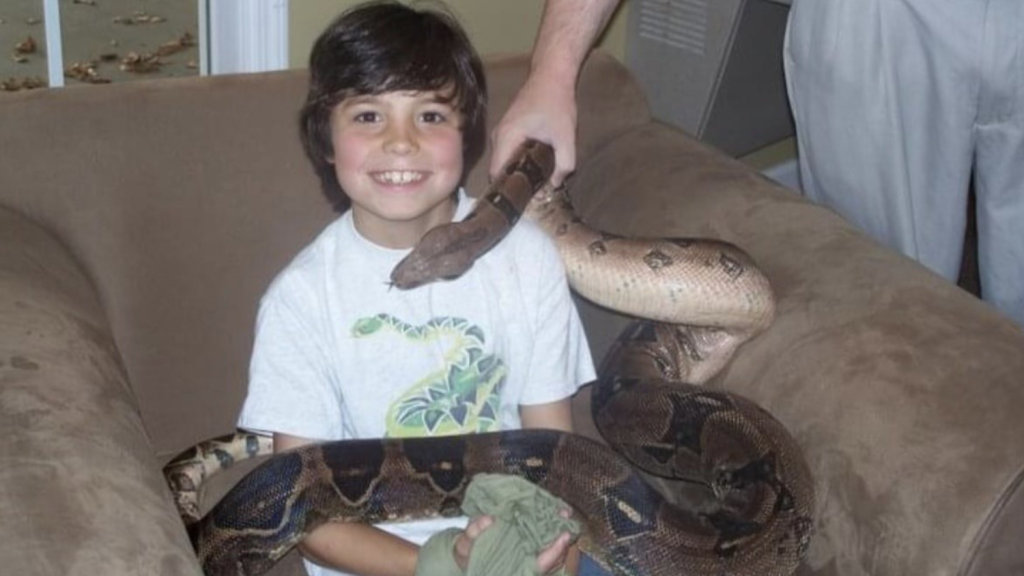
Though I’ve been interested in reptiles and amphibians since my childhood, my interest in disease didn’t come until I entered my first research lab at the University of Florida. I conducted research on the chytrid fungus, which has caused global declines in amphibian populations, and I was shocked at the massive impact that a pathogen can have on an entire community of host organisms. The field of disease ecology is incredibly complex and dynamic, particularly in the face of climate change and globalization, and since I was first introduced to it I have been excited to explore it deeper!
What do you think is the most pressing issue related to global change?
Due to globalization and climatic shifts, pathogens are being spread to wildlife, plants, crops, and livestock that do not share the same evolutionary history, meaning they lack the necessary defenses to fight infections appropriately. This unnatural spread is a major factor contributing to disease-mediated declines across the world, which pose a massive threat to humans and ecosystems alike and are often unknown or misunderstood by the public.
About Your Research
What results are you finding?
Because I am so early in my research, we have not had the chance to gather data and investigate my hypotheses. One important thing I have learned from reviewing literature surrounding my topic, however, is that some genetic variants of Ophidiomyces ophidiicola have been in the United States for long periods of time. This allows us to compare enzootic and emerging strains of Oo and parse out the differences in infection virulence, providing management insight that can be applied to many different pathogen systems.
Who will benefit from your research?
The findings from my research will inform future fungal pathogen surveillance strategies and help to conserve snakes by identifying locations and populations that are at the greatest risk to severe Ophidiomyces ophidiicola infections.
How would you describe your research to a 3rd grader?
I study a fungus (we call it Oo), which makes snakes all over the world sick with a skin disease. The disease causes sores on their skin and can make it hard for snakes to survive. We know that many types of Oo exist, but we don’t know which types are worse for snakes than others. We also don’t know if some types prefer hotter or colder weather, which can affect how fast the fungus grows and how well a snake can fight off the sickness. For my research, I am trying to find out how temperature, the type of Oo, and the snake’s immune system affect how bad the disease gets. I will do this by catching snakes in the wild and seeing if they are sick from a type of Oo. I will also grow Oo and snakes in the lab under hot and cold conditions to see which temperatures are the most likely to hurt snakes.
About Your Global Change Research Fellow Experience
How do you expect the SE CASC Global Change Research Fellows Program to impact you and your work?
SE CASC is teaching me skills that I can use during my graduate studies and beyond. Not only am I learning how to design and carry out interdisciplinary research projects, but I am also learning how to effectively share my findings with land managers, peers, and members of the public.
What advice would you give to a student that is interested in getting involved in your field?
My advice to a student interested in getting involved in my field is to not be afraid to ask questions. Curiosity is a wonderful thing!
What has been the most rewarding part or your favorite part of being a SE CASC Global Change Research Fellow?
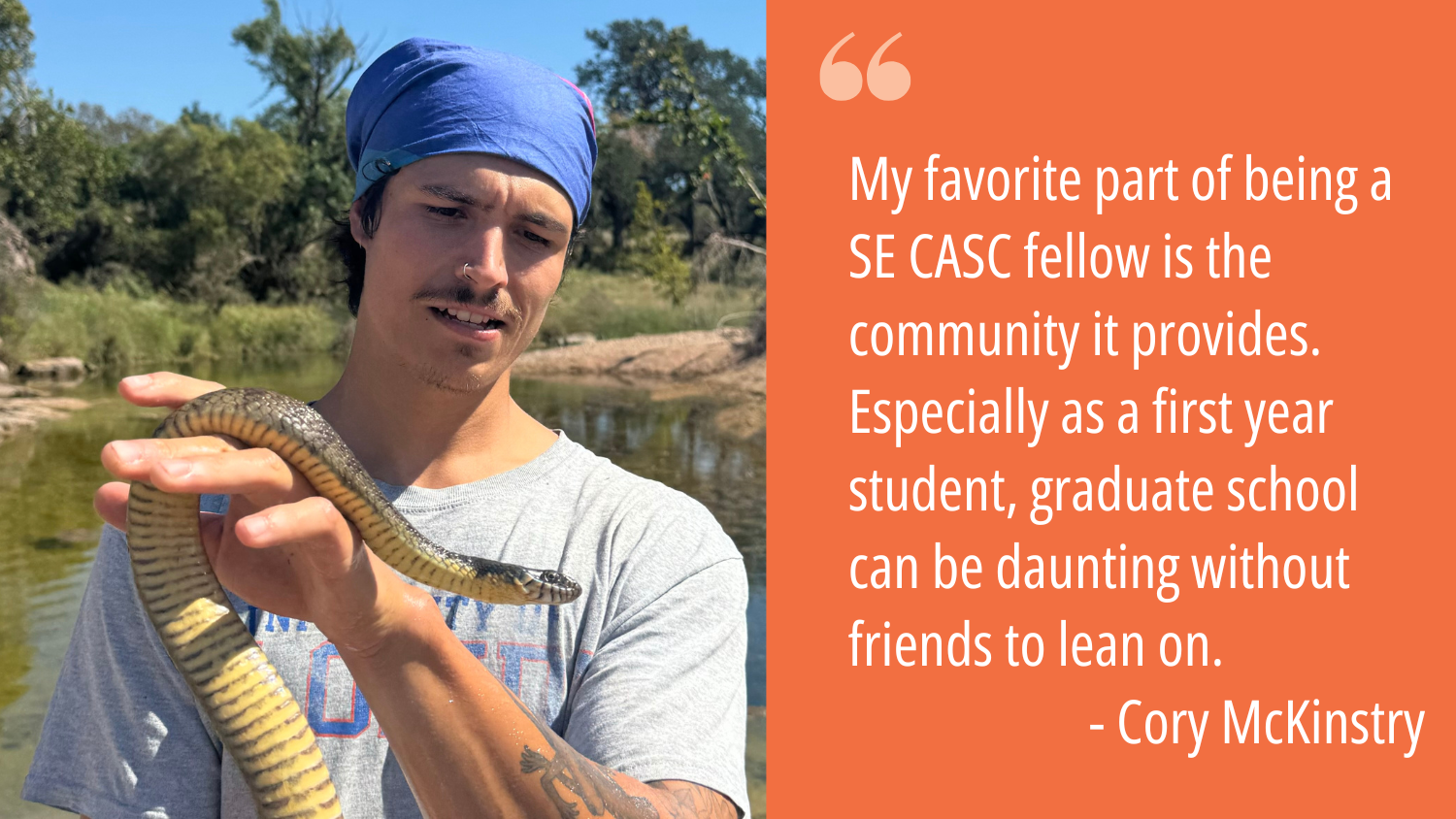
My favorite part of being a SE CASC fellow is the community it provides. Especially as a first year student, graduate school can be daunting without friends to lean on. The Global Change Research Fellowship is comprised of a close knit group of my peers and mentors, each of whom I can ask questions or get feedback from when I am struggling.
Learn more about the Southeast Climate Adaptation Science Center’s Global Change Research Fellows program.
- Categories: