
Support for a Collaborative Conservation Plan Approach in the Southeast
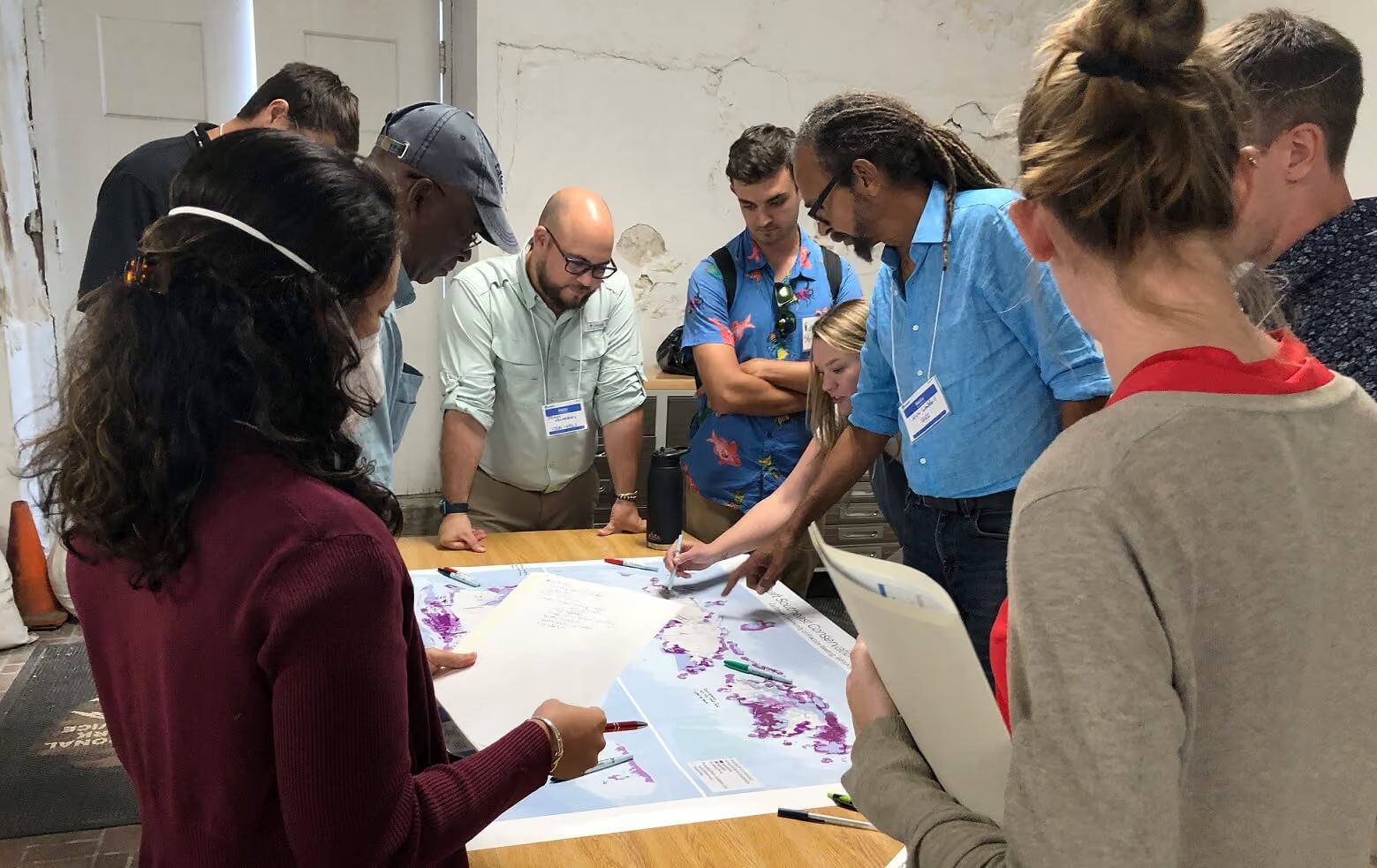
A new study suggests that a collaborative conservation plan for the Southeast is better at prioritizing areas for protection for species under future climate models than randomly selecting priority regions.
In this study, the authors compared the Appalachian subregion of the 2024 Southeast Conservation Blueprint from the Southeast Conservation Adaptation Strategy (SECAS), a conservation priority map, to modeled estimates of future ranges for species of conservation concern.
The forests of the Central and Southern Appalachians are a biodiversity hotspot and home to many rare and endemic species–for example, this region is the center of global salamander diversity. Protecting these species is vital for ecosystem stability, preserving biodiversity, and the accompanying benefits to human health and resources. A species range is the habitat that a species can live and travel within that is suitable for them and may shift with changing climate conditions. This means that where species can survive may change over time, so it’s important to prepare for these changing conditions by establishing conservation areas that will continue to support these species in the future.
“Thinking about how species ranges will change as the climate changes is really important for conservation decision makers,” says lead author and 2024-25 Global Change Research Fellow, Henley Sartin.
To see how well different conservation plans would help in this decision-making, the authors used ecological niche models under four different climate scenarios that cover a range of low to high emissions across three different decades to predict climatically suitable and reachable forested areas for species of conservation concern in the Appalachian region. Then, they compared these models to the 2024 Southeast Conservation Blueprint, and found that its highest and high priority regions performed better than a random selection at identifying the regions important for species. The researchers also compared the Blueprint results to those from a conservation plan that prioritized the cheapest lands and one that prioritized conservation of the rarest species. Results consistently showed that the highest and high priority regions of the Blueprint performed well across different climate scenarios and time periods. Highest priority regions also performed better at capturing regions for rare species than a cheapest land protection strategy. This suggests that the Blueprint is an effective tool for choosing areas for protection of these species.
“These are really promising results for practitioners that this collaborative conservation plan is going to be a useful tool in the coming decades, no matter what climate scenario comes up,” says Sartin.

The Southeast Conservation Blueprint is unique because it is a collaborative, living spatial plan that identifies priority areas for a connected network of lands and waters across 15 Southeast states and two U.S. Caribbean territories. It is based on a mixture of natural and cultural resource indicators and it evolves over time with changing on-the-ground conditions and input from partners with different backgrounds. It’s this flexibility that goes beyond the species-specific level that makes it such an interesting tool for managers because it offers a holistic look at the region without compromising on reliability.
“We’re not going to be able to solve climate change by just protecting one species, we need an interdisciplinary approach,” notes Sartin, “and this provides another example of how collaborative work is useful.”
The paper, “Representation of potential species ranges under future climate scenarios by a collaborative conservation plan” was published in the Journal of Wildlife Management on October 14, 2026. The paper was co-authored by Narayani Barve, Samuel M. Jantz, Seong-Hoon Cho, and Paul R. Armsworth.
- Categories: